
Mortgage broker in Neuchâtel: finance your property purchase

- Neuchâtel: a canton where the property market varies sharply by region
- An older housing stock: plan for works before calculating the financing
- Lods can materially change the cash required for a purchase
- Land and building contract: watch the transfer-duty assessment base
- The full land-register extract contains information missing from the public extract
- Prepare the financing before committing
- Compare lenders beyond the mortgage rate
- Frequently asked questions about property financing in Neuchâtel
Financing a home in Neuchâtel is not simply about obtaining an attractive mortgage rate. Regional differences, the age of a significant part of the housing stock and cantonal acquisition costs can mean that two projects with the same purchase price require very different amounts of cash.
The role of a mortgage broker in Neuchâtel is therefore to assess your affordability, the structure of your equity, the characteristics of the property and the criteria of the institutions that may be willing to finance it.
Neuchâtel: a canton where the property market varies sharply by region
The canton is not a uniform property market. Cantonal vacancy statistics illustrate these differences well: on 1 June 2026, the vacancy rate was 0.95% on the Littoral, 3.08% in the Montagnes, 0.71% in Val-de-Ruz and 1.59% in Val-de-Travers.
These figures clearly do not determine a property’s bank value or mortgage approval on their own. They do, however, show why a house in Val-de-Ruz, a condominium in Neuchâtel or an apartment in La Chaux-de-Fonds should not be analysed as interchangeable properties.
The bank values the property securing the loan. It therefore considers the precise location, condition, characteristics and comparable properties available on the market. The price agreed with the seller is only one element of that analysis.
An older housing stock: plan for works before calculating the financing
One characteristic of the canton deserves particular attention: in 2024, 41.6% of residential buildings had been built before 1946, while only 14% dated from the 2001–2024 period.
At the same time, 60.6% of the canton’s homes are in buildings containing several dwellings. For buyers, this means that renovation issues and condominium ownership (PPE) are far from marginal considerations.
An apartment may fit perfectly within your bank-approved budget and still require a significant contribution shortly after purchase for renovation of the roof, façades, heating system, windows or building envelope.
Before buying an older condominium, it is therefore useful to request the co-ownership regulations, the latest meeting minutes, the accounts, the amount held in the renovation fund and the list of works already approved or under consideration.
This review answers a different question from the bank’s: not only “Can I buy this home?”, but also “Will my budget remain comfortable if major works become payable after the purchase?”.
Lods can materially change the cash required for a purchase
In the Canton of Neuchâtel, transfer duties are known as lods. They are payable by the buyer unless the notarised deed provides otherwise.
Neuchâtel property taxation distinguishes in particular between a main residence and other acquisitions: the standard rate is 3.3%, while a property intended to be used durably as the buyer’s main residence is taxed at 2.2%, provided in particular that it is occupied for at least two years.
For a home costing CHF 800,000, this represents CHF 17,600 in lods at 2.2%, compared with CHF 26,400 at 3.3%, a difference of CHF 8,800.
This amount does not replace the equity required by the lender. It is added to the acquisition budget and must therefore be anticipated in the cash available.
The rule becomes even more relevant when a property has more than one use. If one part is your main residence and another part is rented out, the tax authority may apply the 2.2% rate to the part corresponding to your home and the 3.3% rate to the part that does not meet that condition, according to the allocation used for the property.
For a project combining a main residence with rental income, the legal structure and use of the property can therefore directly affect the amount of cash required at the time of purchase.
Land and building contract: watch the transfer-duty assessment base
Another Neuchâtel-specific point is worth knowing before signing a construction project.
When the purchase of land is linked to a building contract treated as the acquisition of a turnkey construction, lods are not necessarily calculated only on the land. Cantonal legislation provides that they may be calculated on the total price including both the land and the building.
The canton’s official example shows land costing CHF 150,000 linked to construction costing CHF 550,000: for a future main residence, lods are calculated on CHF 700,000 rather than only on the CHF 150,000 land price.
For the buyer, the consequence is very practical: a construction budget that appears to have a comfortable buffer can lose several thousand francs of cash if acquisition costs were estimated on the wrong basis.
The full land-register extract contains information missing from the public extract
In Neuchâtel, there is an important distinction between the simplified public land-register extract and the full extract.
According to the cantonal geomatics and land-register service, the public extract does not include annotations, non-public notices or liens. The full extract contains this information and is used in particular for processing a mortgage deed and for obtaining or renewing a mortgage.
This distinction matters before a purchase: an easement, annotation, charge or existing lien is not merely an administrative detail. These elements need to be understood by the notary, lender and buyer before the financing is definitively committed.
For a condominium, the canton can also provide the plans filed when it was created. This makes it possible to check more precisely which units and ancillary areas are legally attached to the unit being purchased.
Prepare the financing before committing
Good preparation does not mean automatically sending the same application to ten banks. It means first understanding which institutions are likely to accept your profile and the property concerned.
Before approaching lenders, a broker reviews in particular:
- your fixed and variable income;
- the source and composition of your equity;
- the possible use of your second pillar or pillar 3a;
- your loans, leases, maintenance payments or other financial commitments;
- the property’s price, value and condition;
- any works and the budget that should remain available after the purchase;
- affordability according to the criteria applied by lenders;
- the amortisation strategy and intended mortgage structure.
For an initial assessment, prepare your latest payslips, recent tax return, proof of equity, occupational pension certificate and pillar 3a statements if you intend to use them. Self-employed applicants will generally also need company accounts and additional documents.
Once the property has been identified, add the sales documentation, land-register extract, available plans and, for a condominium, the relevant co-ownership documents.
Compare lenders beyond the mortgage rate
The interest rate is important, but it is not enough to determine which mortgage is best suited to your project.
Two institutions may display similar rates while valuing the same property differently, recognising certain income or equity differently, or applying different conditions for duration, amortisation, early repayment and transfer in the event of a sale.
For a SARON mortgage, you should also compare the lender’s margin and contractual rules, not just the reference rate.
The broker’s role is therefore to compare the acceptability of the application, the cost and the constraints of the financing as a whole, not just the rate displayed when the application is made.
Reviews from our clients in Neuchâtel
Frequently asked questions about property financing in Neuchâtel

How much are transfer duties when buying property in Neuchâtel?
In the Canton of Neuchâtel, transfer duties, known as lods, are generally 3.3% of the transfer price. The rate is 2.2% when the property is intended to be used durably as the buyer’s main residence and is occupied for at least two years.
These duties are added to the purchase price and should be included in the cash budget before the financing is structured.
For a construction project, are lods calculated only on the price of the land?
Not necessarily. When the purchase of land is linked to a building contract that is treated as the acquisition of a turnkey construction, Neuchâtel rules provide for lods to be calculated on the total price, including both the land and the building.
This cost should therefore be included in the budget before the contracts are signed.
Why request a full land-register extract before arranging financing?
The simplified public extract does not include annotations, non-public notices or liens. The full extract contains this information and is used in particular for processing a mortgage deed and for obtaining or renewing a mortgage.
It therefore helps identify important legal elements before any final commitment is made.
Is an older building more difficult to finance in Neuchâtel?
Not automatically. The age of the building alone does not determine a bank’s decision. However, the property’s condition, necessary renovations, future costs and the value accepted by the lender can affect the equity requirement or the budget available after the purchase.
For a condominium, it is particularly useful to review the meeting minutes, renovation fund and any works already approved.
How much does a mortgage broker in Neuchâtel cost?
For private clients, our introduction and brokerage service is without obligation and is not billed to the client when financing is completed through our service. The broker is then remunerated by the lender.
Find us throughout Switzerland
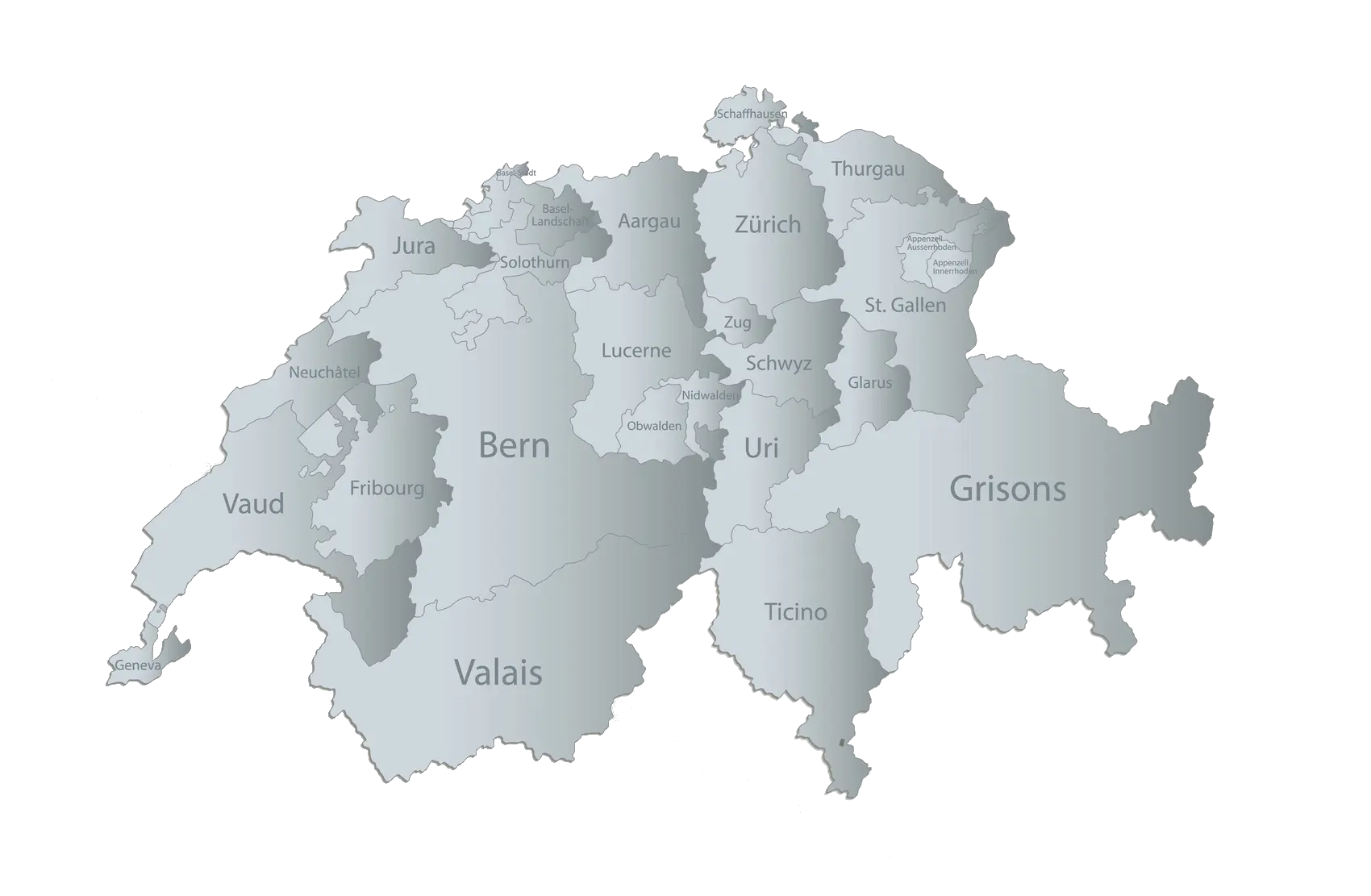
Zoomez et cliquez sur le canton désiré.
Disclaimer: The information on this page is provided for general information only and does not constitute a financing offer or personalised legal, tax or financial advice. The Neuchâtel cantonal rules mentioned, particularly those concerning transfer duties, the land register and acquisitions linked to building contracts, may change and their application depends on the specific circumstances of the buyer and the property. Lending and valuation conditions vary between lenders. The examples and calculations shown should therefore be checked on a case-by-case basis with the relevant professionals and authorities.