
Mortgage broker in Fribourg: finance your property purchase

- How does our mortgage brokerage service in Fribourg work?
- Fribourg is not a uniform property market
- Growth in condominium ownership: what to check before buying
- First home: a Fribourg tax benefit worth knowing
- Purchase price and bank valuation: when more equity is required
- Bilingual canton, land register and mortgage security
- Prepare your financing before making an offer
- Compare mortgages on more than the interest rate
- Frequently asked questions about property finance in Fribourg
Financing an apartment in Fribourg, a condominium in Bulle or a house in an outlying municipality involves more than comparing a few mortgage rates. The type of property, the value accepted by the bank, the structure of your equity and certain canton-specific costs can materially change the budget needed for the purchase.
The role of a mortgage broker in Fribourg is therefore to assess how lenders will view your project and then select institutions whose criteria genuinely match your circumstances.
How does our mortgage brokerage service in Fribourg work?
Are you looking to finance a home in Fribourg, Bulle, Murten, Düdingen, Estavayer or elsewhere in the canton? Our team collects the initial details of your project before putting you in touch with a partner mortgage broker. The broker assesses your affordability, the origin of your equity and the property’s characteristics before seeking a solution from lenders whose criteria fit your application.
The process involves three steps:
- Present your project: municipality, property type, proposed price, equity, income and purchase timetable.
- Check feasibility: bank valuation of the property, loan-to-value ratio, theoretical costs and any missing documents.
- Compare proposals: interest rates, terms, amortisation, early-exit conditions and the requirements of each lender approached.
How much does this service cost? For private clients, when financing is completed through our assistance, the broker is remunerated by the lender and the client is not charged for the service. The arrangements applicable to your case can be clarified before proceeding. The broker cannot guarantee either approval of your application or the lowest rate on the market.
Fribourg is not a uniform property market
The canton has an interesting characteristic: in 2024, 42.3% of occupied homes were owner-occupied, compared with 35.7% across Switzerland. Yet this varies considerably by area: in the Sarine district, particularly the Fribourg agglomeration, the owner-occupier rate was only 27.5% during 2022–2024.
In other words, describing the “Fribourg property market” as a single uniform market conceals important differences between the Fribourg agglomeration, Bulle and Gruyère, municipalities in the Singine district, the Lake district, Broye and Veveyse.
For financing, these differences mainly affect property types, price levels and comparable properties. A bank assesses not only the borrower but also the property securing the mortgage.
Growth in condominium ownership: what to check before buying
Fribourg’s housing stock has changed considerably. At the end of 2024, the canton had 168,373 homes, an increase of 59.6% since 2000. Between 2021 and 2024, multi-unit buildings accounted for 57.8% of net new residential buildings, compared with just 24.6% between 2000 and 2010.
This trend is particularly visible in centres such as Fribourg and Bulle, as well as Villars-sur-Glâne, Marly, Düdingen, Murten, Châtel-Saint-Denis and Estavayer.
For buyers, this means that an increasing share of available properties is in apartment buildings and under condominium ownership (PPE). However, financing a condominium should involve more than checking the apartment’s price.
Before buying, it is useful to review the condominium regulations, minutes of recent owners’ meetings, the renovation fund balance, the co-ownership accounts and any major works already approved or planned. Renovating a roof, façade, heating system or building envelope may lead to additional capital calls after the purchase, even if your bank financing appeared perfectly affordable on the day you signed.
These documents do not replace the bank’s assessment of the property, but they help distinguish being able to buy from being able to afford to keep the property comfortably after purchase.
First home: a Fribourg tax benefit worth knowing
Following amendments to Fribourg’s transfer-duty legislation, the purchase of a first home intended to become the buyer’s main residence may qualify for a reduction in the taxable amount.
The Fribourg law on transfer duties and duties on real-estate security rights currently provides for:
- a CHF 500,000 reduction in the assessment base where the combined price of the land and building does not exceed CHF 1,000,000;
- a CHF 250,000 reduction where the combined price is between CHF 1,000,001 and CHF 1,500,000;
- no reduction where the combined price exceeds CHF 1,500,000.
In particular, the property must be used immediately as the buyer’s main residence and remain so continuously for at least two years.
Important when buying jointly: if only one co-buyer meets the first-home conditions, the reduction may be limited to the share they acquire. The notarial deed must also contain the declarations required by law. If the occupancy conditions are subsequently not met, the tax saved may have to be repaid. Ask the notary to check the calculation before finalising your equity arrangements.
This rule does not reduce the 20% equity typically required by a bank: it is a benefit relating to transfer duties. It can, however, reduce the cash you need in addition to the equity required for financing.
Simplified example: for a qualifying first home bought for CHF 850,000, the assessment base for cantonal transfer duties may be reduced by CHF 500,000 to CHF 350,000. At the cantonal rate of 1.5%, this means CHF 5,250 in cantonal duties rather than CHF 12,750, before any additional municipal charges and other acquisition costs.
This illustrates how an expense may leave bank-calculated affordability unchanged while affecting the cash actually needed to become a homeowner.
Purchase price and bank valuation: when more equity is required
Buyers naturally focus on the price agreed with the seller. The bank also considers the value it recognises for the property as mortgage security.
Suppose an apartment is bought for CHF 850,000, but the lender assigns it a collateral value of CHF 810,000. If the institution finances no more than 80% of that value, the maximum mortgage would be CHF 648,000.
The buyer would therefore have to cover CHF 202,000 of the price from their own resources, plus acquisition costs. If the bank valuation equalled the CHF 850,000 purchase price, 80% financing would amount to CHF 680,000. In this example, CHF 32,000 in additional equity is needed solely because of the valuation gap.
Two institutions may also assess the same property at different values. This is why it can be helpful to have your financing reviewed before signing an irrevocable purchase commitment or paying a non-refundable deposit.

Bilingual canton, land register and mortgage security
Fribourg is one of Switzerland’s officially bilingual cantons: French and German are its two official languages. The Singine district is predominantly German-speaking, the Lake district is bilingual and the city of Fribourg itself lies on the language border.
This is not an obstacle to mortgage financing, but it can have a practical consequence: depending on the municipality and those involved, property documents, correspondence and administrative records may be prepared in French or German. The essential point is to avoid misunderstanding or overlooking an important part of the application merely because it is written in the other language.
The completeFribourg land register extract provides information on the property description, form of ownership, easements, land charges, priority notices, annotations and security rights. These details help establish what is legally attached to the property before the financing is finalised.
Another frequently overlooked cost is the cantonal duty on real-estate security rights, equal to 0.75% of the amount entered in the land register, particularly when a new security right must be created or an existing one increased. The actual cost depends on the legal arrangements already in place and should be checked with the notary and land registry.
Finally, building insurance against fire and natural hazards is mandatory in the canton, with the buildings concerned insured through the cantonal building insurance institution. For house buyers, this is another administrative consideration when ownership transfers from seller to buyer.
Prepare your financing before making an offer
The aim is not to send the same application to as many banks as possible, but to identify institutions able to finance your profile and the type of property you wish to buy.
Before approaching lenders, a broker will typically examine:
- your fixed and variable income;
- your equity and its origin;
- the potential use of your second pillar or pillar 3a ;
- your loans, leasing agreements, maintenance payments and other obligations;
- the property’s value and characteristics;
- affordability calculated according to the lender’s criteria;
- the required amortisation and proposed mortgage structure.
For an initial assessment, prepare your latest payslips, a recent tax return, evidence of equity, your pension fund certificate and pillar 3a statements if you intend to use them. Self-employed applicants will generally also need business accounts and additional documents.
Once you have found the property, complete the application with the land register extract, sales documentation, plans and, for a condominium, the relevant co-ownership documents.
Compare mortgages on more than the interest rate
The interest rate matters, but on its own it does not determine which offer is truly the most advantageous.
Two institutions may offer similar rates but impose very different conditions regardingamortisation, the term, mortgage tranches, early repayment, transfer upon sale or the margin on a SARON mortgage.
A mortgage that is slightly cheaper today can become costly if it significantly limits your flexibility when selling, renewing or dealing with a change in family circumstances.
The broker’s job is therefore to compare costs, lending criteria and contractual restrictionsrather than only the first line of an interest-rate table.
Before choosing an offer, ask in particular which lenders were actually consulted, whether the accepted bank valuation is final, what happens if you sell before the end of the term and how the broker is remunerated. A useful comparison should reveal differences in contractual conditions even where the rates look similar.
Our client reviews
Frequently asked questions about property finance in Fribourg

Does the first-home transfer-duty benefit reduce the equity required by the bank?
No. The Fribourg reduction applies to the assessment base for transfer duties, not to the loan-to-value ratio applied by the bank.
It may nevertheless reduce some acquisition costs that must be paid from your own cash. The statutory conditions need to be checked in each case.
How much does a mortgage broker in Fribourg cost?
For private clients, our brokerage service is without obligation and is not billed to the client when financing is completed through our assistance. The broker is then remunerated by the lender.
Which documents should I review before buying a condominium in Fribourg?
In addition to the sales documentation and land register extract, it is useful to review the condominium regulations, recent owners’ meeting minutes, the co-ownership accounts, the renovation fund and any major works already decided upon or being considered.
These documents help anticipate charges or additional contributions that are not always apparent from the purchase price.
Does the canton’s bilingualism affect mortgage financing?
Mortgage lending criteria remain the same, but some property or administrative documents may be issued in French or German, depending on the area and parties involved.
It is essential to understand the information relating to the property, particularly easements, charges, annotations and security rights, before making a final commitment.
Do I need to find a property before contacting a broker?
No. An initial assessment helps estimate a realistic budget, check your equity and identify potential weaknesses in your application before making an offer.
If you have already found a property, it is preferable to have the financing checked before signing a purchase commitment or paying a non-refundable deposit.
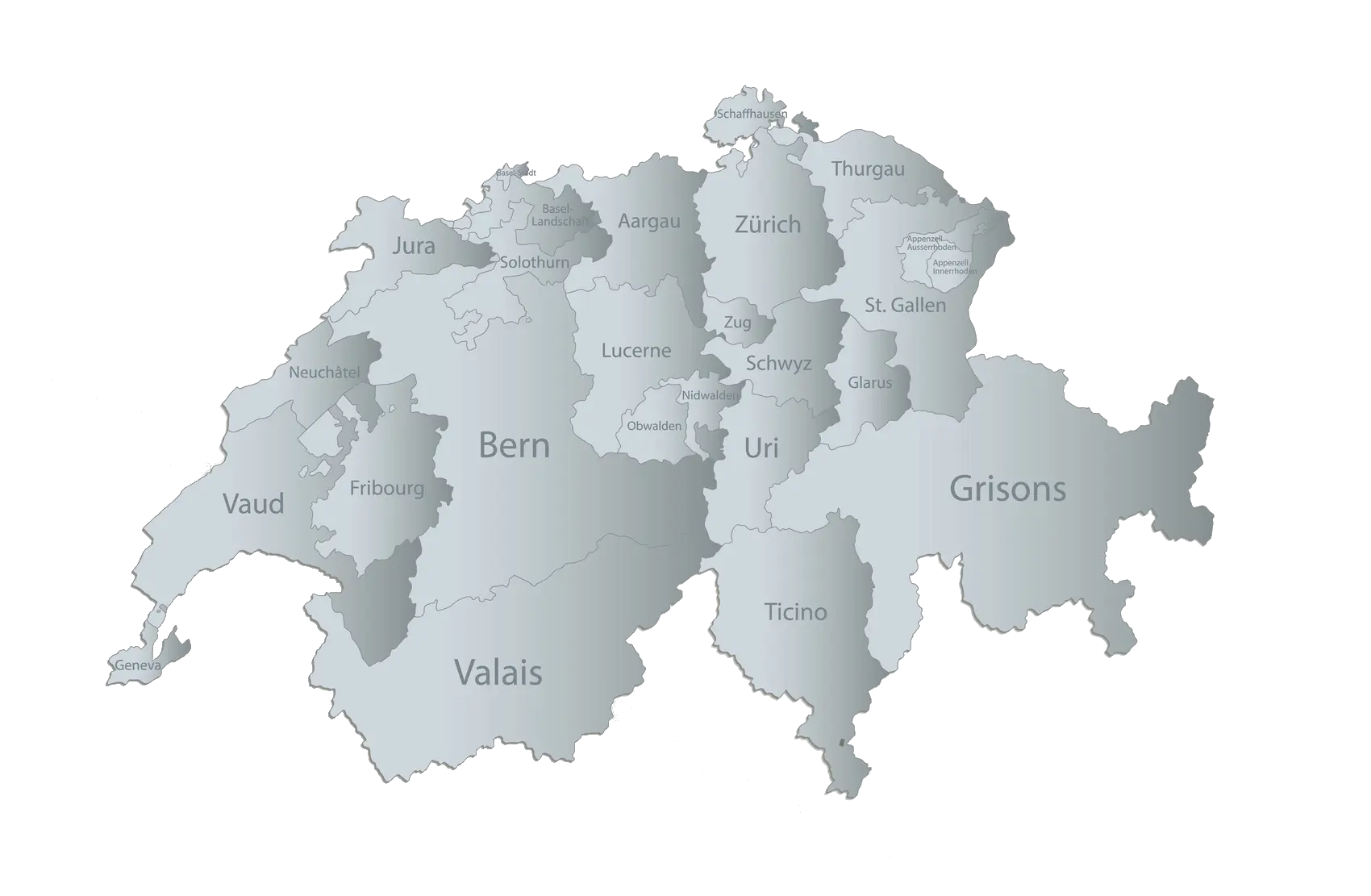
Find us throughout Switzerland
Zoomez et cliquez sur le canton désiré.
Disclaimer: The information on this page is provided for general information only and does not constitute a financing offer or personalised legal, tax or financial advice. The Fribourg cantonal rules mentioned, particularly those concerning transfer duties, real-estate security rights and building insurance, may change and their application depends on the buyer’s and property’s specific circumstances. Mortgage financing conditions vary between lenders. All figures, examples and calculations should therefore be checked on a case-by-case basis with the appropriate professionals and authorities.