
Mortgage broker in Valais: finance your property purchase

- How does a mortgage broker in Valais work?
- Valais is not a single mortgage market
- Second homes: lenders’ requirements can differ considerably
- The bank’s property valuation can matter more than the rate
- Lex Weber, natural hazards and restrictions: check the property before applying
- Property transfer tax and mortgage security: calculate the cash required
- Documents to prepare when comparing lenders
- Frequently asked questions
Finding a mortgage in Valais is not simply a matter of sending the same application to several banks and choosing the lowest interest rate. The canton includes very different property projects: a main residence in the Rhône valley, a flat in Sion or Visp, a chalet in a mountain resort, a second home, a major renovation, a new build or a property subject to use restrictions.
A mortgage broker in Valais primarily helps you identify lenders whose criteria genuinely suit the property and your financial profile, then compare their terms on a like-for-like basis. This page focuses on how to structure and negotiate your financing in practice.
How does a mortgage broker in Valais work?
Our team first reviews the characteristics of your property project in Valais, then puts you in touch with a suitable partner mortgage broker. The broker checks the property’s specific features, prepares applications and identifies banks, insurers or other institutions that may be able to provide appropriate financing. The aim is not to send the same application everywhere, but to obtain genuinely comparable responses.
- Establish your purchasing capacity: sustainable income, existing commitments, age, second-pillar occupational pension and pillar 3a, equity and a cash reserve.
- Classify the property: main residence or second home, condominium (PPE), chalet, new build, renovation, rental investment property or unusual property.
- Identify potential issues: the bank’s valuation, permitted use, building work, natural hazards, land-use restrictions or any authorisation required to purchase.
- Involve a partner broker and select suitable lenders according to the property, your financial profile and lending policies, rather than approaching every lender indiscriminately.
- Compare complete offers: interest rates, accepted property value, mortgage amount, equity, amortisation, SARON margin, fees, term and early-exit conditions.
This selection is particularly valuable for non-standard applications: second homes, variable income, self-employment, purchases close to retirement, chalets requiring renovation, construction projects or properties that are difficult to value against comparable sales.
Our service is free and carries no obligation for private individuals. When financing is arranged through our service, the partner broker is generally remunerated by the lender. Offers should be compared based on their overall cost and conditions, rather than solely on the advertised rate.
Valais is not a single mortgage market
Banks assess more than the canton. They also consider the municipality, the property’s intended use, its resale prospects, its condition and the availability of comparable properties for valuation purposes.
A home in Monthey or Martigny, a condominium apartment (PPE) in Sion, a house in Brig-Glis and a chalet in Verbier or Zermatt may therefore require different financing strategies, even at similar purchase prices.
Valais has another practical characteristic: the canton uses both French and German. For a property in Upper Valais, the property documents, local contacts and some correspondence with the authorities may be in German. This does not prevent financing, but it makes a clear, unambiguous application all the more important.
Before approaching lenders, we therefore classify the project correctly: a standard main residence, a second or holiday home, a new build or renovation, a rental investment property or an unusual property. This first step avoids wasting time with institutions whose criteria do not match the project.
Second homes: lenders’ requirements can differ considerably
This is one situation where a mortgage broker’s role becomes particularly valuable. There is no single equity percentage that applies to every second home.
Lenders’ published requirements already illustrate the differences. In an article published in February 2026, Banque Cantonale du Valais states that a second home requires at least 30% equity, compared with 20% for a main residence. UBS explains that holiday homes generally require 40% equity.
These published thresholds are indicative rather than binding mortgage offers: the property’s accepted value, its intended use, the borrower’s affordability and each lender’s policies may require more equity. The key point is that the same buyer and the same property may result in very different financing structures depending on the lender.
For a second home, the source of the equity also needs to be checked. Pension assets allocated to the Swiss home ownership promotion scheme generally cannot be used to finance a privately used holiday home. An applicant who appears to have sufficient wealth may therefore be short of accessible funds if a substantial part is held in the second pillar or pillar 3a.
The bank’s property valuation can matter more than the rate
In resorts and for unusual properties, saving a few tenths of a percentage point on interest can be far less important than obtaining a realistic valuation from the lender.
Imagine a chalet purchased for CHF 800’000 and assessed by two institutions. First lender: it accepts a mortgage lending value of CHF 760’000 and a maximum loan-to-value ratio of 70%, resulting in a mortgage of CHF 532’000 and an equity requirement of CHF 268’000 before purchase costs. Second lender: it values the property at CHF 720’000 and limits its loan-to-value ratio to 60%, resulting in a CHF 432’000 mortgage and CHF 368’000 equity before costs. At the same purchase price, the difference in cash required is CHF 100’000. This example is illustrative: these valuations and ratios do not represent actual bank offers.
The mortgage rate does not explain this difference: it results from the combination of the accepted property value and the loan-to-value ratio. The broker should compare these factors before negotiating a few tenths of a percentage point in interest. It is particularly prudent to have the specific property assessed before paying a non-refundable deposit or making a purchase commitment without a financing condition.
A certificate of financial affordability based only on your income does not replace a property valuation. In a resort, permitted use, access, the condition of the chalet or condominium, planned work and ease of resale may all affect the accepted value.

Lex Weber, natural hazards and restrictions: check the property before applying
For many property projects in Valais, a legal and land-use check should come before the bank’s assessment. A mortgage broker does not replace the notary or the municipal authorities, but should identify issues that could prevent or alter financing.
- Second homes: in municipalities where second homes exceed the statutory 20% threshold, the creation of new second homes is generally restricted, subject to legal exceptions. The property’s exact status and any restrictions on use should be checked against the guidance issued by the Federal Office for Spatial Development.
- Natural hazards: the canton maps risks including avalanches, flooding, debris flows and unstable slopes. The official hazard maps and applicable regulations may reveal significant restrictions affecting a plot.
- Hazard zones: a red zone may prohibit construction, while a blue zone may require expert assessments and protective measures for a building project.
- Land Registry and PLR cadastre: easements, encumbrances, public-law restrictions, rights of way and existing mortgage charges should be understood before the financing is finally approved.
These checks are particularly important for chalets, sloping plots, major renovations and properties whose value depends heavily on their second-home status. They may affect the scope for alterations, future costs and resale value.
To explore these issues without turning this brokerage page into a general guide, see our detailed guide to property financing in Valais.
Property transfer tax and mortgage security: calculate the cash required
Purchase costs should not be confused with the equity required by the bank. Under Articles 14 and 18 of the Valais law on property transfer tax, transactions valued at no more than CHF 1’000 are exempt from the proportional tax. The cantonal charge is CHF 20 for values between CHF 1’001 and CHF 50’000, then 1% from CHF 50’001 to CHF 500’000, 1.3% from CHF 500’001 to CHF 1’000’000 and 1.5% from CHF 1’000’001.
The municipality may add a tax of up to 50% of the cantonal charge. On a CHF 800’000 purchase, the 1.3% cantonal tax amounts to CHF 10’400. If the municipality applies the maximum surcharge, another CHF 5’200 is due, bringing the property transfer tax to CHF 15’600 before other costs.
The law also provides for a 0.2% tax on certain deeds creating or increasing mortgage security rights from CHF 20’001. Notary fees and Land Registry charges must be calculated separately. Our page on property transfer tax in Valais explains these expenses in more detail.
For financing purposes, the key point is simple: these amounts must be available in addition to the equity required by the lender. Even a project that qualifies with 20% equity may leave insufficient cash if the ancillary costs have been underestimated.
Documents to prepare when comparing lenders
For an initial assessment, prepare the usual personal documents: payslips, a recent tax assessment or tax return, proof of equity, your occupational pension statement, pillar 3a assets and details of any loans, leasing agreements or other financial commitments.
Once you have identified the property, the supporting property documents become equally important:
- sales particulars, plans, floor areas and property description;
- Land Registry extract and details of encumbrances;
- for a condominium (PPE): regulations, meeting minutes, accounts and the renovation fund;
- quotes and specifications if renovation work is planned;
- permitted-use status if the property is in a municipality affected by second-home regulations;
- information from the PLR cadastre and hazard maps where relevant;
- confirmation from the notary if the buyer could be subject to Lex Koller.
The earlier these points are clarified, the more meaningful the comparison between offers. This helps avoid obtaining a theoretical ‘yes’ based on your income, followed by a refusal or a reduced mortgage once the bank has examined the property.
Frequently asked questions
Why use a mortgage broker when buying property in Valais?
Because different lenders may assess the same project very differently, especially for a second home, chalet, resort property or unusual property. A broker therefore compares not just interest rates, but also the accepted property value, required equity, treatment of income, amortisation and contractual conditions.
Does a second home in Valais always require 40% equity?
No. The amount of equity required depends on the lender, the property and the borrower’s circumstances. For example, Banque Cantonale du Valais stated a minimum of 30% for a second home in February 2026, while UBS generally refers to 40% for holiday homes. The bank’s valuation and lending criteria may require a higher contribution.
Does Lex Weber prevent second-home financing in Valais?
No. The Second Homes Act mainly restricts the construction of new second homes in municipalities exceeding the statutory threshold of 20%. The property’s exact status, construction date, any restrictions on use and municipal rules must be checked before arranging financing.
Why do lenders check natural hazard maps?
Because a hazard zone may impose building restrictions, expert assessments or protective measures. These factors can affect future works, insurability, ease of resale and therefore the value a lender is willing to accept as security.
How much is property transfer tax in Valais?
Transactions valued at no more than CHF 1’000 are exempt from the proportional tax. The cantonal charge is CHF 20 between CHF 1’001 and CHF 50’000, then 1% from CHF 50’001 to CHF 500’000, 1.3% from CHF 500’001 to CHF 1’000’000 and 1.5% from CHF 1’000’001. A municipality may add a tax of up to 50% of the cantonal amount. Notary fees, Land Registry charges and any creation of a mortgage charge are additional.
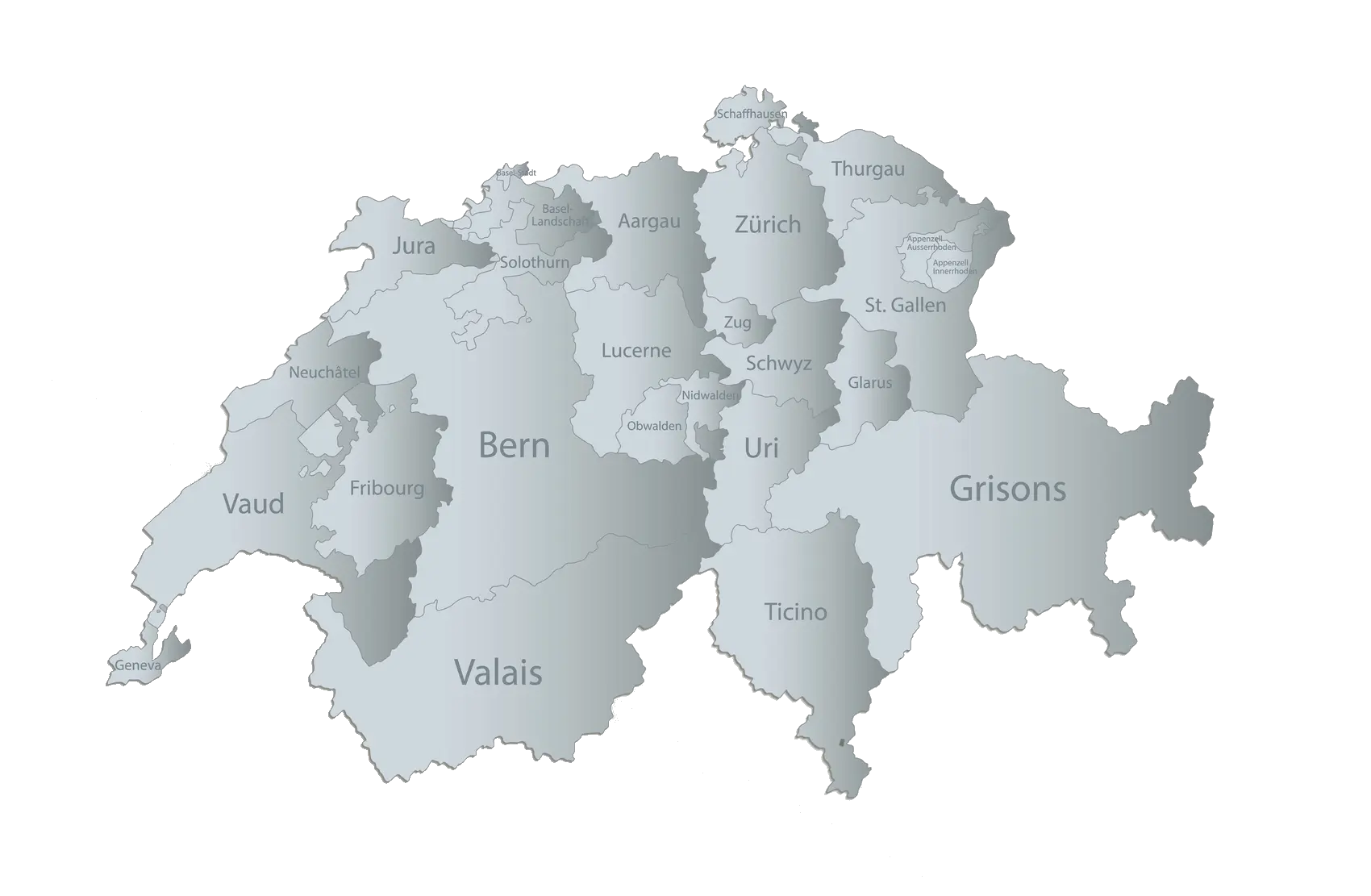
Find us throughout Switzerland
Zoomez et cliquez sur le canton désiré.
Disclaimer: The information on this page is provided for general information only and does not constitute a financing offer or personalised legal, tax or financial advice. Lending policies vary between institutions and may change. Rules on second homes, acquisitions by persons abroad, property transfer taxes and natural hazard zones depend on the property, the municipality and the buyer’s circumstances. Before making any binding commitment, check legal and land-use matters with the notary and competent authorities, and have the lender confirm financing for the specific property.