
Mortgage in Valais: financing, costs and local rules

- Valais property market: three very different markets
- Purchase price and bank valuation: what to secure before making an offer
- Main home, second home or tourist use: financing changes
- Lex Weber: pre-existing legal status can strongly affect property value
- Foreign buyers: do not confuse Lex Weber with Lex Koller
- Natural hazards and PLR cadastre: an essential check in Valais
- Property transfer tax and mortgage costs: the real calculation
- Equity and affordability: two concrete examples
- Documents to check before committing
- Compare lenders: the accepted value matters as much as the rate
- Frequently asked questions about mortgages in Valais
- Secure your property project in Valais
Buying in Valais is not simply a matter of applying standard Swiss mortgage rules to a mountain canton. Between a primary residence in Sion, an apartment in Visp, a chalet in Verbier and a second home in Zermatt, the bank is not financing the same risk, the same use or the same resale liquidity. Valais also has particularly important rules concerning second homes, purchases by certain persons abroad, natural hazards and property transfer taxation.
This page therefore focuses on the factors that can genuinely change your financing: the bank value of the property, residential status, Lex Weber, Lex Koller, property restrictions, natural hazards, transfer tax, mortgage certificates and the actual level of equity required. Standard mortgage products are covered separately in our dedicated guides.
Valais property market: three very different markets
Valais had 376,113 residents on 31 December 2025, an increase of 1.3% in one year according to cantonal statistics. But speaking of a single “Valais property market” would be misleading: financing dynamics differ significantly between the Rhône plain, the centres of Upper Valais and the tourist resorts.
- Rhône plain and residential centres — Sion, Sierre, Martigny, Monthey and some neighbouring municipalities are primarily markets for main residences. Banks can generally rely on more comparable transactions and permanent local demand.
- Upper Valais — Visp, Brig-Glis and the industrial or residential municipalities linked to the employment basin operate differently from the resorts. The local market, language, commuter flows and industrial projects can influence residential demand.
- Tourist resorts — Zermatt, Verbier, Crans-Montana, Nendaz and Saas-Fee combine high prices, a large proportion of second homes and sometimes atypical properties. Resale value depends more heavily on permitted use, accessibility, ownership structure and the number of potential buyers.
For your financing, the exact municipality and type of property are therefore more important than a cantonal average price per square metre. A house in Sion and an older chalet in a resort can have the same price and still result in two completely different bank assessments.
Purchase price and bank valuation: what to secure before making an offer
As elsewhere in Switzerland, the mortgage lender does not necessarily calculate the mortgage on the price you have agreed to pay. It generally uses the lower of the purchase price and the value it accepts for the property. This rule becomes particularly important in resorts where buyers may pay a premium for a view, a rare location, ski access or a sought-after second-home status.
Example: a CHF 900,000 price but a CHF 850,000 bank valuation
You buy an apartment for CHF 900,000. The bank nevertheless estimates its lending value at CHF 850,000. If it finances a maximum of 80% of that value, the mortgage is CHF 680,000. Your contribution is therefore not CHF 180,000 but CHF 220,000, before acquisition costs.
The CHF 40,000 gap must be funded from your own liquid assets. For a second home, the lender may adopt an even more conservative policy and require more equity. A financing certificate based only on your income therefore does not replace approval of the specific property.
Before paying a non-refundable deposit or making a purchase offer without a financing condition, request an initial bank valuation of the property. In a resort where some properties are rare, this step may matter more than a few tenths of a percentage point on the mortgage rate.

Main home, second home or tourist use: financing changes
The same apartment can result in a different financing file depending on its intended use. Before comparing rates, clarify with the municipality, notary and lender whether the property will be a main residence, a privately used second home or accommodation subject to tourist operation.
For a main residence, standard financing rules may, subject to conditions, allow pension assets to be used for part of the equity. For a privately used second home, banks often require more “hard” equity, and 2nd-pillar assets are generally not intended to finance this type of purchase.
If the property is to be rented by the week or operated for tourism, do not assume that the bank will include 100% of the estimated rental income in its affordability calculation. Seasonal income dependent on snowfall, occupancy or an operating company may be taken into account with a substantial safety margin or excluded altogether, depending on the lender.
Lex Weber: pre-existing legal status can strongly affect property value
The Federal Act on Second Homes generally limits the creation of new second homes in municipalities where they represent more than 20% of the housing stock. Many tourist municipalities in Valais are affected. However, a common simplification should be avoided: “municipality above 20% = impossible to buy a second home”.
A key factor is the legal status of the dwelling. A dwelling created under the previous legal regime is one that legally existed or had a final building permit on 11 March 2012. According to the Federal Office for Spatial Development, and subject to additional cantonal or municipal restrictions, such a dwelling may in principle be used freely as a main or second residence.
By contrast, a newer dwelling may be subject to a use restriction requiring it to be used as a main residence or for tourist accommodation. That restriction should be checked in the building permit and, where relevant, in the applicable entries or annotations.
Why this status matters directly to the bank
The permitted use affects the number of potential buyers on resale. An apartment that may legally be used as a second home can appeal to a broader group of buyers than a property that must be used as a main residence in a resort with limited permanent local demand. This difference can therefore affect the property’s liquidity and the value accepted by the lender.
Before buying in a resort, ask explicitly: when was the dwelling created, is there a use restriction, is a change of use permitted, and could the planned renovation alter that status? Major alterations or the creation of additional dwellings may be subject to different rules.
Foreign buyers: do not confuse Lex Weber with Lex Koller
Lex Weber mainly regulates the proportion and use of second homes. Lex Koller, by contrast, governs property acquisitions by certain persons abroad. They are two distinct legal regimes that can apply simultaneously to the same project.
Valais law provides in particular that certain persons abroad may, subject to conditions and applicable quotas, obtain authorisation to purchase a holiday home or an apartment in an aparthotel in designated tourist locations. The cantonal regulation was adjusted again in 2026 for certain tourist regions.
For a buyer subject to Lex Koller, the bank may wait until the legal ability to acquire the property has been clarified before finalising the financing. In that case, do not sign an irrevocable commitment as though the authorisation were merely a formality. The notary should establish your status and any authorisation requirement at an early stage.
Natural hazards and PLR cadastre: an essential check in Valais
Because of its topography, Valais is particularly exposed to natural hazards. The canton maintains hazard maps for avalanches, floods, debris flows, rockfalls, landslides and other ground instabilities. It also states that it is the Swiss canton most exposed to seismic hazard.
These maps are not merely informational documents. The canton states that their content and associated requirements are integrated into municipal land-use plans and become binding for the affected plots. A hazard zone can therefore influence the ability to build, alter or rebuild.
- Consult the Valais PLR cadastre for public-law restrictions applicable to the plot.
- Review the municipality’s natural-hazard maps: avalanche, flooding, debris flow, rockfall, landslide or other instability.
- Check the land-register extract for easements, rights of way, encumbrances, usufructs and mortgage rights that may supplement the PLR information.
- For a chalet or house on a slope, check year-round access, retaining walls, protective structures and any required or recommended works.
For the bank, these factors can affect resale value and future works. A chalet with an exceptional view but difficult access or special restrictions is not automatically valued like a standard property in the same resort.
Property transfer tax and mortgage costs: the real calculation
For property transfer tax, cantonal law provides for a proportional scale based on the value of the transaction:
- CHF 20 for a value from CHF 1,001 to CHF 50,000;
- 1% for a value from CHF 50,001 to CHF 500,000;
- 1.3% for a value from CHF 500,001 to CHF 1,000,000;
- 1.5% from CHF 1,000,001.
The municipality may also levy an additional tax of up to 50% of the cantonal tax. The total therefore depends on the municipality and should be confirmed with the notary before you finalise your budget. Our guide to property transfer tax in Valais explains the mechanism in detail.
Example: purchase at CHF 550,000
For a CHF 550,000 purchase, the cantonal tax is 1.3%, or CHF 7,150. If the municipality applies the maximum 50% supplement, this adds CHF 3,575. The transfer tax then reaches CHF 10,725 before other costs.
The mortgage certificate also generates costs
Valais law also provides for a tax of 0.2% on certain instruments creating a real estate pledge. Land-register fees are additional. For a register mortgage certificate or a mortgage, the cantonal ordinance provides in particular for a proportional fee of 1‰, subject to statutory minimum and maximum amounts.
This means you should distinguish three categories: the cost of transferring ownership, notarial and land-register costs, and the costs of setting up the real estate security. If an existing mortgage certificate can be taken over or adapted, the notary and bank should determine what can be saved.
Equity and affordability: two concrete examples
The general rules on affordability also apply in Valais: the lender usually stress-tests your file using an imputed rate close to 5%, plus amortisation and maintenance costs. The theoretical burden must remain compatible with your gross income, often at around one third.
Primary residence at CHF 650,000
Assuming 80% financing, the equity requirement starts at CHF 130,000. But you must still add transfer tax, notary, land-register and any mortgage-certificate costs. If the bank accepts a value below the price paid, the difference increases your actual contribution further.
Second home at CHF 1,200,000
The calculation is more demanding. The lender may require more than 20% equity and insist that it comes mainly from cash or freely available assets. 2nd-pillar assets are generally not available for a privately used second home. Lex Weber status, the property’s liquidity and any seasonal rental income are also part of the assessment.
 Our mortgage calculator provides a first estimate of your affordability. For a property in a resort, have the property value and permitted-use status checked separately afterwards.
Documents to check before committing
For a purchase in Valais, a fast file is not just a file containing your payslips. Documents relating to the property are often just as important as the borrower’s documents.
- sales file, plans, floor areas and property description;
- land-register extract and cadastral information;
- main/second-home status and any use restriction;
- date the dwelling was created or authorised if Lex Weber is relevant;
- PLR extract and natural-hazard maps;
- for a condominium: regulations, minutes, accounts and renovation fund;
- for an older chalet: work estimates, condition of the roof, heating system and building envelope, access and any protective structures;
- if the buyer may be subject to Lex Koller: confirmation from the notary regarding the procedure and any required authorisation.
These documents enable the lender to answer the two essential questions: Can the household afford the debt, and does the property constitute sufficiently secure and marketable collateral?
Compare lenders: the accepted value matters as much as the rate
Valais is precisely the kind of canton where two lenders can reach very different conclusions on the same property. A bank that knows a resort well may have solid local comparables; another institution may offer a slightly lower rate but use a more conservative valuation or require more equity.
Compare at least: accepted property value, maximum amount financed, required equity, treatment of rental income, amortisation, interest rate, SARON margin, exit conditions and the ability to transfer the mortgage.
For an atypical chalet, a second home or a buyer subject to a special procedure, obtaining a more appropriate valuation can be financially much more important than saving 0.10 percentage point on the interest rate.
Frequently asked questions about mortgages in Valais
Does Lex Weber prohibit buying a second home in Valais?
No. It mainly limits the creation of new second homes in municipalities where their share exceeds 20%. A dwelling created under the previous legal regime may, subject to other restrictions, remain freely usable as a main or second residence. The exact status of the property must be checked.
Can a foreign buyer purchase a chalet in Valais?
It depends on the buyer’s status, place of residence, type of property and intended use. Certain acquisitions by persons abroad require authorisation under Lex Koller and, for holiday homes, are also subject to quotas and authorised tourist locations. The notary should clarify this before any binding commitment.
Is property transfer tax 0.3% in Valais?
No, not for an ordinary property sale. The cantonal tax is progressive and amounts to 1%, 1.3% or 1.5% depending on the value, with a possible municipal supplement of up to 50% of the cantonal tax.
Why does the bank care about the hazard map?
Because a restriction related to an avalanche, flood, ground instability or another hazard can affect alteration possibilities, future costs and resale. The bank may therefore take it into account in its valuation.
Can the 2nd pillar be used for a second home?
In principle, occupational pension assets used under the home-ownership promotion scheme relate to the main home occupied by the insured person. A privately used second home must therefore be financed with other equity.
Should you automatically choose the Cantonal Bank of Valais?
No. Its knowledge of the local market can be useful, but the entire financing package should be compared. An offer with an attractive rate may become less appealing if the accepted value is lower or the equity requirements are stricter.
Secure your property project in Valais
In Valais, the right sequence is to define your affordability, identify the property’s lawful use, check restrictions on the plot, obtain an initial bank valuation, calculate the costs and then compare lenders.
This approach is particularly important in resorts, where permitted use, pre-existing legal status, natural hazards and the resale buyer pool can directly affect the collateral value. On the Rhône plain, the same checks remain useful, but their relative importance may differ.
You can submit your Valais project to us so that financing solutions can be compared for the specific property and your profile.
Find us throughout Switzerland
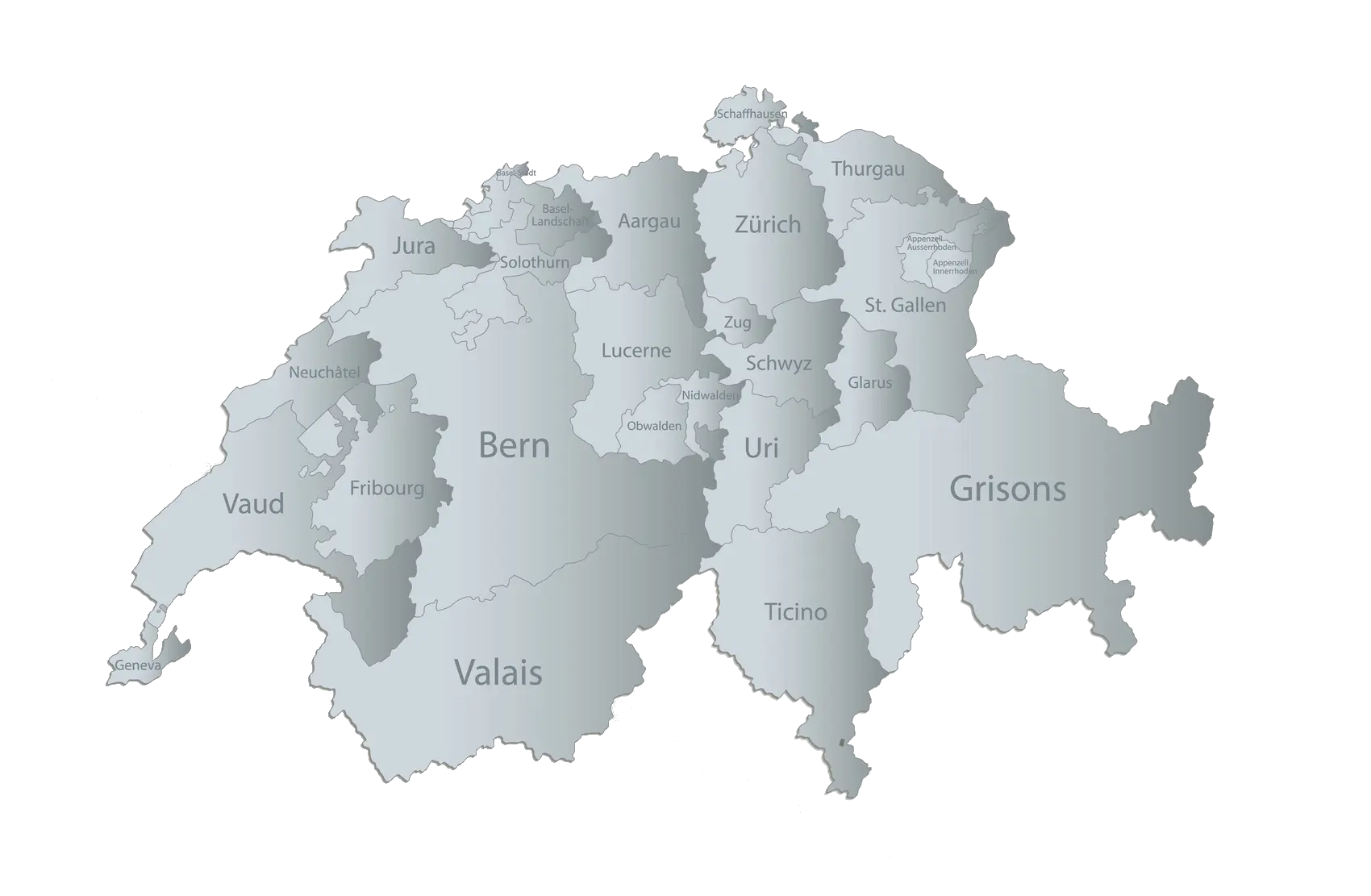
Zoomez et cliquez sur le canton désiré.
Disclaimer: This article is for information purposes only. Rules governing second homes, acquisitions by persons abroad, property transfer taxes, property restrictions and lending criteria may change. Always verify the current situation of the municipality, plot and buyer with the notary, competent authorities and lender before entering into any commitment.