Mortgage in Lausanne: financing property in a tight market

- Why the Lausanne market changes how you should prepare your mortgage
- Purchase price and bank valuation: the main risk
- Lausanne, Prilly, Pully: do not confuse the city with the wider urban area
- Buying a condominium in Lausanne: the checks that matter
- Transfer tax and acquisition costs in Lausanne
- RDPPF, land register and restrictions: check the property before making an offer
- Affordability: why 20% equity is not always enough
- Prepare a file that can move quickly
- Compare lenders: the rate is only part of the offer
- Frequently asked questions about mortgages in Lausanne
- Secure your property purchase in Lausanne
In Lausanne, the main risk is not choosing the “wrong” type of mortgage. It is committing to a price before knowing how the lender values the property and how much cash the purchase will actually require. In a tight market, an attractive apartment may receive several offers while the bank relies on its own mortgage lending value.
This guide focuses on what can genuinely change a Lausanne financing file: the gap between purchase price and bank value, the purchase of condominium ownership, transfer tax, renovation funds, property restrictions, future works and theoretical affordability. The different mortgage products are deliberately left to the pages that cover them in detail.
Why the Lausanne market changes how you should prepare your mortgage
The housing market remains very tight. In the district of Lausanne, the housing vacancy rate was 0.63% in 2025. The canton generally considers a market balanced at around 1.5%. In 2026, Vaud Statistics reported that the rate in the Lausanne district remained stable. The shortage is therefore not just an impression: it is officially measured.
This scarcity can create time pressure: grouped viewings, short deadlines for submitting an offer, and sellers favouring buyers whose financing is already prepared. But the bank does not automatically follow that logic. It is not required to finance the price you accepted.
Good preparation therefore means separating two questions: “how much can I borrow?” and “how much is the bank willing to lend on this specific property?”. In Lausanne, the second question can become decisive.
Purchase price and bank valuation: the main risk
In Switzerland, maximum financing is generally calculated using the lower of the price paid and the value accepted by the lender. When a highly sought-after property receives several offers, this rule can create an equity requirement well above the simple 20% calculation.
Example: CHF 64,000 in additional cash
You buy an apartment for CHF 1,200,000, but the bank accepts a value of only CHF 1,120,000. If it finances 80% of that value, the maximum mortgage is CHF 896,000. Your contribution therefore becomes CHF 304,000 before costs, instead of CHF 240,000 under the simplified 20% calculation.
The CHF 64,000 difference does not necessarily mean the seller is asking an unreasonable price. A lake view, a high floor, a terrace, exceptional renovation or a particular micro-location may have special value to buyers, while the bank’s model weights these factors differently.
Before paying a non-refundable deposit or making an unconditional commitment, ask whether an initial valuation can be obtained from the sales file. A pre-approval (financing certificate) based on your income is not yet approval of the property.

Lausanne, Prilly, Pully: do not confuse the city with the wider urban area
A common mistake is to treat the entire urban area as if it belonged to the City of Lausanne. Prilly, Pully, Renens and Ecublens are separate municipalities. This can change municipal taxation, the comparable data used for valuation and certain administrative procedures.
Even within Lausanne, the differences are significant. Sous-Gare/Ouchy, Chailly/Rovéréaz, Montchoisi, Florimont, Béthusy, La Sallaz, Vennes and the areas close to Malley do not form a homogeneous market. Chailly, for example, lies east of the city centre — not west as stated in the previous version of this page.
For a bank, slope, road noise, views, parking and the energy performance of the building or ease of resale may matter more than a general average price per square metre. Compare the property with genuinely similar properties located in the same municipality.
Buying a condominium in Lausanne: the checks that matter
For an apartment held as condominium ownership, the condition of the apartment alone is not enough. The lender is indirectly financing your share of the entire building. Façades, roof, lift, heating, insulation, pipes or parking facilities can therefore affect the analysis of the file.
Request the latest owners’ meeting minutes, the condominium regulations, accounts, budget, approved works and the balance of the renovation fund. A well-funded reserve is useful only if it is sufficient in relation to future investment needs.
Example: a condominium can hide CHF 100,000 of future funding needs
Suppose an energy renovation costing CHF 2.5 million is planned and your ownership share is 4%. If the renovation fund does not cover the work, your potential exposure reaches CHF 100,000. Even if the apartment itself is perfectly renovated, this future cost can reduce your financial margin.
Also check the exact legal status of parking spaces, cellars and ancillary rooms: separate condominium unit, exclusive-use right or common part. This difference can affect value and resale.
Transfer tax and acquisition costs in Lausanne
In the canton of Vaud, the cantonal transfer tax is 2.2%. The municipality may add up to half the cantonal tax, i.e. 1.1%. In Lausanne, the usual combined rate therefore reaches 3.3%. The Canton of Vaud explains the rule and the exceptions.
On a purchase price of CHF 1,200,000, 3.3% already represents CHF 39,600. Notarial fees, land-register charges and the cost of creating or adapting the mortgage certificate may be added.
These costs must be kept separate from the equity used to finance the purchase price. A buyer who has exactly 20% of the price but no additional reserve may therefore discover too late that the financing is incomplete.
Also ask the notary whether an existing mortgage certificate can be taken over or adapted. Depending on its form, amount and the lender’s requirements, this may avoid having to create an entirely new one.
RDPPF, land register and restrictions: check the property before making an offer
Before negotiating the rate, check the property itself. Two properties offered at the same price may present very different legal or structural risks.
- Consult the Vaud RDPPF cadastre : zoning, water protection, contaminated sites, forest restrictions, noise, building lines and other public-law restrictions may appear there.
- Review the land-register extract: easements, rights of way, usufructs, rights of residence, annotations and mortgage rights can affect use or value.
- For an older or protected building, check what alterations are genuinely possible before including future appreciation in your plan.
- Check nearby urban-development projects, nuisances and building restrictions when location is an important part of the price.
The RDPPF cadastre does not replace the land register: the canton itself notes that some restrictions must be checked in one and others in the other. For larger transactions, Vaud’s LPPPL may also introduce a municipal pre-emption right; however, the canton specifies that the isolated sale of a condominium apartment is not subject to it.
Affordability: why 20% equity is not always enough
The “20%” is only the beginning of the calculation. For an owner-occupied primary residence, the lender also checks the source of the equity and the theoretical affordability.
Lenders generally use an imputed interest rate of around 5%, add amortisation and a maintenance allowance, and then compare the result with gross income. The theoretical burden should usually remain around one third of gross household income.
In Lausanne, the price level makes this test particularly restrictive. Adding equity can reduce the debt, but only if you still retain enough cash for transfer tax, fees, works and a safety reserve.
 Use our mortgage calculator to test several scenarios, but treat the result as a preliminary affordability assessment rather than approval of the property.
Prepare a file that can move quickly
In a tight market, useful speed comes from preparation, not haste. Before serious viewings, gather your personal documents and define your price limit.
- recent salary certificates and, depending on the lender, your employment contract;
- latest tax return and available tax assessment;
- evidence of savings, securities, pillar 3a and pension-fund assets;
- details of loans, leasing and other recurring commitments;
- sales file, plans, land-register extract and cadastral data;
- for a condominium: minutes, accounts, budget and renovation fund;
- for a property requiring renovation: quotations or a credible estimate of the works.
You then obtain three separate assessments: your borrowing capacity, the bank value of the property and its legal/technical quality. Until all three are sufficiently secure, a simple “agreement in principle” should not be treated as a binding mortgage offer.
Compare lenders: the rate is only part of the offer
Two banks may quote almost the same rate yet produce very different financing outcomes. One may accept a higher value, while the other applies a stricter method to variable income, self-employed borrowers or certain buildings.
Compare at least: accepted value, maximum financed amount, rate, SARON margin, amortisation, exit conditions, the possibility of transferring the mortgage and any required ancillary products.
In an expensive market, saving 0.10 percentage point on the rate can sometimes matter less than avoiding CHF 50,000 or CHF 100,000 of additional equity caused by a more conservative valuation.
Frequently asked questions about mortgages in Lausanne
Do you need exactly 20% equity in Lausanne?
No. You must meet the equity structure required by the lender, but you must also finance any gap between the price and the bank value as well as the acquisition costs.
Is the transfer tax really 3.3% in Lausanne?
In the ordinary case, yes: 2.2% cantonal plus 1.1% municipal. The exceptions and taxable basis are specified by the Canton of Vaud.
Can I make an offer before the bank has approved the property?
You can express your interest, but avoid an irreversible commitment or a non-refundable deposit until the bank has sufficiently assessed the specific property.
Is Prilly part of Lausanne?
No. Prilly belongs to the Lausanne urban area but is a separate municipality. The exact municipality should be used for taxes, comparable data and market analysis.
What should you check first in a condominium?
The minutes, planned works, renovation fund, accounts, ownership quotas, any disputes and the legal status of parking spaces or ancillary rooms.
Secure your property purchase in Lausanne
The safest sequence is: define your purchasing capacity, prepare the file, analyse the property, obtain an initial bank valuation, calculate all costs and only then decide how far you are prepared to go on price.
This approach avoids two costly mistakes: overpaying for a property that the bank values below your offer and using all your cash for the equity contribution without keeping a reserve for costs, condominium expenses or works.
You can submit your Lausanne project to us to compare financing options based on the specific property and your profile.
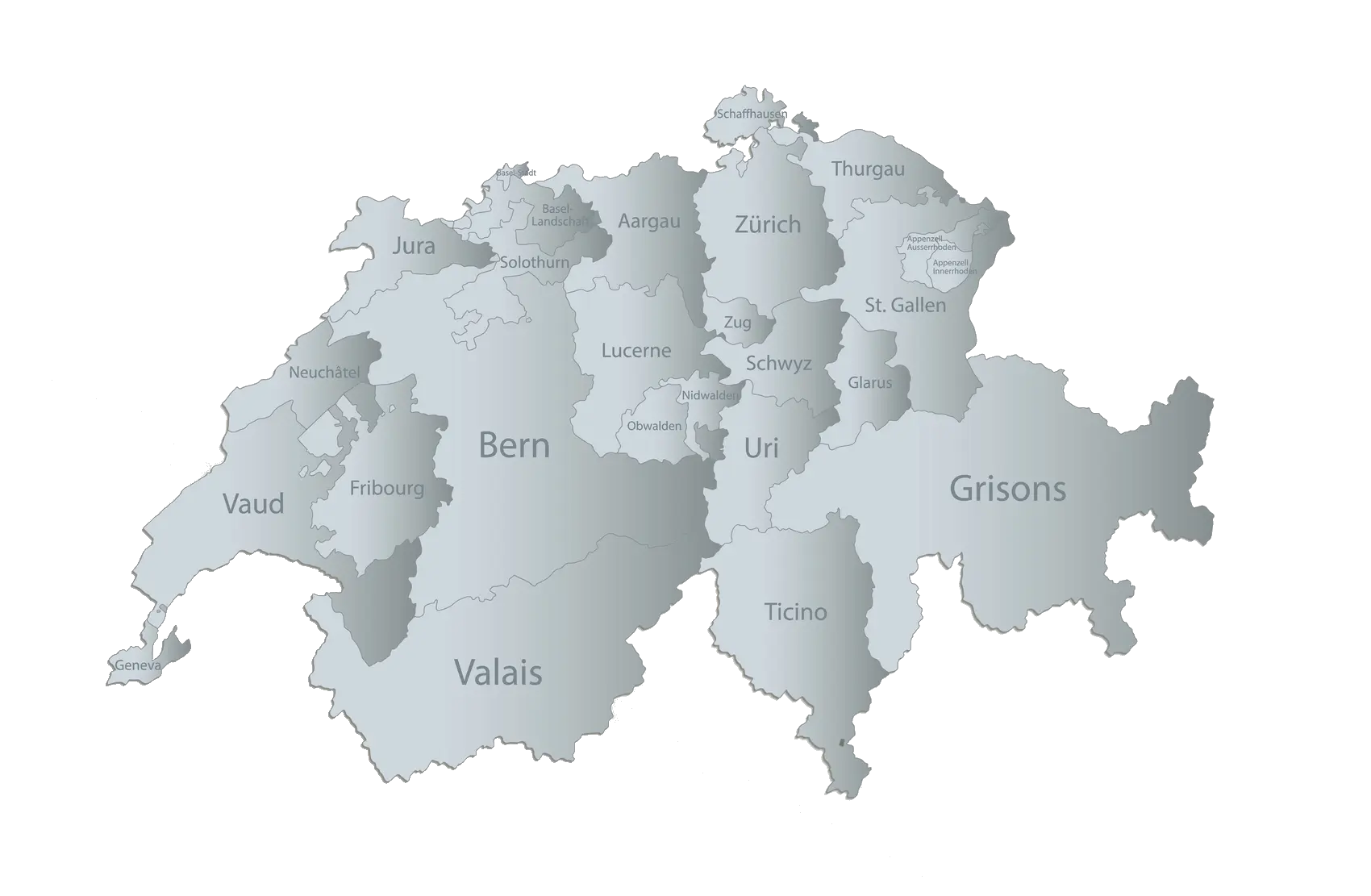
Find us throughout Switzerland
Zoomez et cliquez sur le canton désiré.
Disclaimer: This article is provided for information purposes only. Financing criteria, rates, bank valuations, taxes, fees and administrative rules may change and depend on the property and the buyer’s situation. Verify current information with the canton, municipality, notary and lender before making any commitment.