
Mortgage in Appenzell: financing property in Innerrhoden and Ausserrhoden

- Two cantons, two mortgage contexts
- Why property valuation matters more in a small market
- Older, rural and atypical properties: points to check
- Checks to perform before applying for financing
- Purchase costs: Innerrhoden and Ausserrhoden are not identical
- Which lenders are active in Appenzell?
- How much equity may you actually need?
- Prepare the mortgage file before making a binding offer
- Innerrhoden or Ausserrhoden: what changes for financing?
- Frequently asked questions
- Prepare your Appenzell property purchase
Buying a home in Appenzell Innerrhoden (AI) or Appenzell Ausserrhoden (AR) is not simply the same Swiss mortgage process with a different postcode. The two cantons are small, their property markets are relatively local, and certain houses are difficult to compare with standard urban properties. For a lender, the decisive issue can therefore be less the advertised purchase price than the value it is prepared to accept as mortgage security.
This guide focuses on the points that can genuinely change an Appenzell financing file: bank valuation, market liquidity, transfer taxes, land-register and ÖREB checks, renovation risk and the choice of lenders. The aim is not to repeat the general rules of Swiss mortgages, but to show where an Appenzell purchase deserves additional attention.
Appenzell: two cantons, two mortgage contexts
Appenzell Innerrhoden and Appenzell Ausserrhoden are two separate cantons, historically referred to as half-cantons. The distinction matters for a property purchase because taxes, land-registry organisation, public-law restrictions and local administrative procedures are not identical.
Innerrhoden is the least populated Swiss canton, with 16,960 residents at the end of 2025 according to the canton. It covers roughly 172 km², which makes it the second-smallest canton by area after Basel-Stadt. Its territory also includes the district of Oberegg, which is geographically separated from the inner part of the canton. These details matter because the local housing stock and the number of comparable transactions can vary significantly between Appenzell, Schwende-Rüte, Gonten, Schlatt-Haslen and Oberegg.
Ausserrhoden is larger and more closely connected to the St. Gallen employment area. Herisau, Teufen, Speicher, Gais, Trogen, Heiden and Urnäsch do not form one homogeneous market either. A house with good commuter access and a conventional residential layout is not assessed in the same way as an isolated older building or a property with substantial land.
Why property valuation matters more in a small market
Swiss lenders normally base the maximum mortgage on the lower of the purchase price and the value accepted by the lender. In a market with many recent sales of similar apartments, estimating that value is relatively straightforward. In a small or heterogeneous market, the bank may have fewer directly comparable transactions and therefore apply a more cautious valuation.
Innerrhoden provides an unusually useful source for understanding local activity: the canton publishes property transfers quarterly. These lists are not a substitute for a professional valuation, but they confirm an important characteristic of the market: the number and type of transactions can be examined locally instead of relying only on nationwide price averages.
Example: when 20% equity is no longer enough
Assume that you agree to buy a house for CHF 700,000, but the lender accepts a mortgage value of only CHF 660,000. If it finances 80% of that accepted value, the maximum mortgage is CHF 528,000. You must therefore finance CHF 172,000 yourself, before purchase costs. That is CHF 32,000 more than the simple calculation of 20% of the purchase price.
This is why a financing pre-check should ideally be carried out before you commit to a non-refundable deposit or an unconditional purchase obligation. On a rare property, the seller may be convinced that the price is justified while the lender takes a more conservative view.

Older, rural and atypical properties: points to check
Appenzell contains many buildings whose financing cannot be judged solely from floor area and postcode: older timber houses, converted farmhouses, properties with outbuildings, steep plots, mixed residential and agricultural land, or buildings located in protected village settings. These characteristics can affect both the lender’s valuation and the amount of renovation work it expects after purchase.
For an older house, prepare a realistic renovation budget covering the roof, façade, heating system, insulation, windows, drainage and electrical installations. A bank may accept the purchase price but still require proof that you can finance essential work without exhausting all your liquidity. For major works, a construction or renovation credit can be more appropriate than simply increasing the purchase mortgage.
If agricultural land or an agricultural building is involved, do not assume that standard residential-mortgage rules apply without adjustment. Zoning, agricultural land law, permitted use and resale restrictions can change the financing analysis. The same applies to protected or listed buildings where transformation possibilities may be limited.
Checks to perform before applying for financing
Before asking several lenders for offers, verify the property itself. This avoids negotiating a rate on a file whose main risk has not yet been identified.
- Consult the official ÖREB information for Appenzell Innerrhoden or the Ausserrhoden ÖREB cadastre to identify zoning, groundwater protection, contaminated sites, forest lines and other public-law restrictions.
- Obtain or review the land-register extract. In Innerrhoden, the cantonal land-register/notarial service lists easements, real burdens, annotations and mortgage rights in the extract.
- Check rights of way, usufructs, pre-emption rights, building rights and access conditions. A property that is legally accessible but practically difficult to reach can still raise valuation questions.
- For condominiums, examine the renovation fund, minutes, planned work and any exceptional contributions. A low purchase price is not attractive if substantial communal work is already foreseeable.
- For an older detached house, obtain renovation estimates early enough to present a credible post-purchase budget to the lender.
Purchase costs: Innerrhoden and Ausserrhoden are not identical
The additional cash requirement is another reason not to apply one generic “Appenzell” rule. Appenzell Innerrhoden levies a transfer tax of 1% in the ordinary case. The taxable basis is generally the purchase price, or the market value if it is higher. Land-registry, notarial and mortgage-certificate costs are additional.
In Appenzell Ausserrhoden, transfer tax is governed by cantonal law but levied by the municipalities; the ordinary rate can reach 2%, and municipalities may set a lower rate. The parties may agree whether the seller or buyer bears the tax, while the statutory liability rules still need to be considered. The exact municipality therefore matters before you calculate the cash required at signing.
Purchase costs are normally not the part of the transaction you should expect the mortgage to finance. Keep them separate from the equity required for the property itself and add a liquidity reserve for moving, initial repairs and unforeseen expenses.
Which lenders are active in Appenzell?
A useful Appenzell financing comparison should not stop at a single national bank. Depending on the property and borrower profile, the relevant market can include local and cantonal banks, Raiffeisen banks, national banks, insurance companies and other institutional mortgage lenders.
The Appenzeller Kantonalbank (APPKB) is an obvious local reference, particularly in Innerrhoden and its market area. It distinguishes between fixed-rate mortgages, SARON-based money-market mortgages and a traditional variable mortgage. This is worth stressing: a SARON mortgage is not simply another name for the traditional variable mortgage.
As of October 2026, APPKB also advertises its Wöllkomm mortgage for the purchase or construction of residential property. Subject to its conditions, the product grants a 0.20 percentage-point annual reduction on eligible fixed-rate mortgages of at least five years. This is an example of why local products can be worth checking, but it should always be compared with the total cost and contractual flexibility of competing offers.
Do not choose a lender solely because it knows the region. A bank with excellent local knowledge may value the property confidently, while another institution may offer a lower rate but accept a lower mortgage value. The best offer is the one that works on rate, valuation, equity requirement, amortisation and contractual conditions together.
How much equity may you actually need?
For an owner-occupied primary residence, a standard starting point remains around 20% equity, with lender-specific rules on how much must come from sources other than the 2nd pillar. But the percentage alone is misleading if the bank’s accepted value is below the purchase price.
You should therefore calculate three separate amounts: the minimum equity based on the lender’s value, any gap between purchase price and accepted value, and the acquisition costs that must be paid in cash. A buyer who has exactly 20% of the advertised price but no reserve can be financially weaker than the headline ratio suggests.
The lender also tests affordability, usually using a theoretical interest rate around 5%, plus amortisation and an allowance for maintenance. The resulting annual housing cost should generally stay around one third of gross household income. Your actual interest rate may be much lower; the stress calculation is deliberately conservative.
 Use our mortgage calculator for a first affordability estimate, then have the property itself checked before treating the result as a financing approval.
Prepare the mortgage file before making a binding offer
In a market where an attractive property may receive interest quickly, the advantage is not simply “having a bank”. It is having a file that can be assessed without repeated requests for missing documents.
- recent salary certificates or business accounts if self-employed;
- latest tax return and, where useful, tax assessment;
- evidence of savings, securities, 3a assets and pension-fund assets;
- details of existing loans, leasing contracts and other recurring financial obligations;
- sales documentation, floor plans, cadastral plan and current land-register information;
- for older properties, renovation estimates, energy information and available building documentation;
- for condominiums, regulations, accounts, renovation-fund balance and recent owners’ meeting minutes.
A preliminary lender assessment can then focus on the two questions that matter: can the household carry the debt, and does the lender accept the property at a sufficient value?
An independent mortgage broker can be particularly useful when valuation policies differ between institutions. Comparing only advertised rates is not enough if one lender requires substantially more equity than another.
Innerrhoden or Ausserrhoden: what changes for financing?
The canton should not be chosen on mortgage criteria alone. Nevertheless, the financing implications can differ. Innerrhoden has a smaller market and can offer fewer direct comparables for unusual properties, while Ausserrhoden includes more commuter-oriented locations with broader transaction activity. That does not mean every AR property is easier to finance or every AI property is difficult; the municipality and the individual object remain decisive.
If you expect to sell again within a few years, pay particular attention to the property’s likely resale audience. A highly individual building can be perfectly suitable for you but less liquid for the bank’s risk model. If you plan to keep the property for decades and renovate it gradually, the quality of the building, future investment needs and long-term affordability become more important than short-term marketability.
Frequently asked questions about mortgages in Appenzell
Is 20% equity always sufficient in Appenzell?
No. If the lender values the property below the purchase price, you must cover the difference yourself in addition to the equity calculated on the accepted value. Purchase costs also require separate liquidity.
Does an official property value bind the bank?
No. In Ausserrhoden, the cantonal property valuation authority determines official and market values for public purposes, but a mortgage lender can apply its own valuation method and risk discounts.
Should I choose APPKB automatically for a property in Appenzell?
No. It is a relevant local lender and its knowledge of the region can be useful, but the decision should be based on the complete financing package. Compare valuation, rate, flexibility, amortisation and ancillary conditions.
What is the first local check for an older property?
Start with zoning and public-law restrictions, land-register rights and a realistic renovation assessment. These issues can change both the usable value of the property and the amount a lender is willing to finance.
Prepare your Appenzell property purchase
The most important Appenzell-specific lesson is simple: do not separate the mortgage from the property analysis. In a small market, the financing can depend heavily on how the lender sees the exact building, its legal situation, renovation needs and resale potential.
Before signing, establish the lender’s provisional value, calculate the real cash requirement including transfer taxes and fees, verify the cadastral and land-register information, and compare several institutions. That approach is more useful than choosing a mortgage product first and discovering later that the property itself is the limiting factor.
You can submit your project to compare financing solutions adapted to the property and your borrower profile.
Find us throughout Switzerland
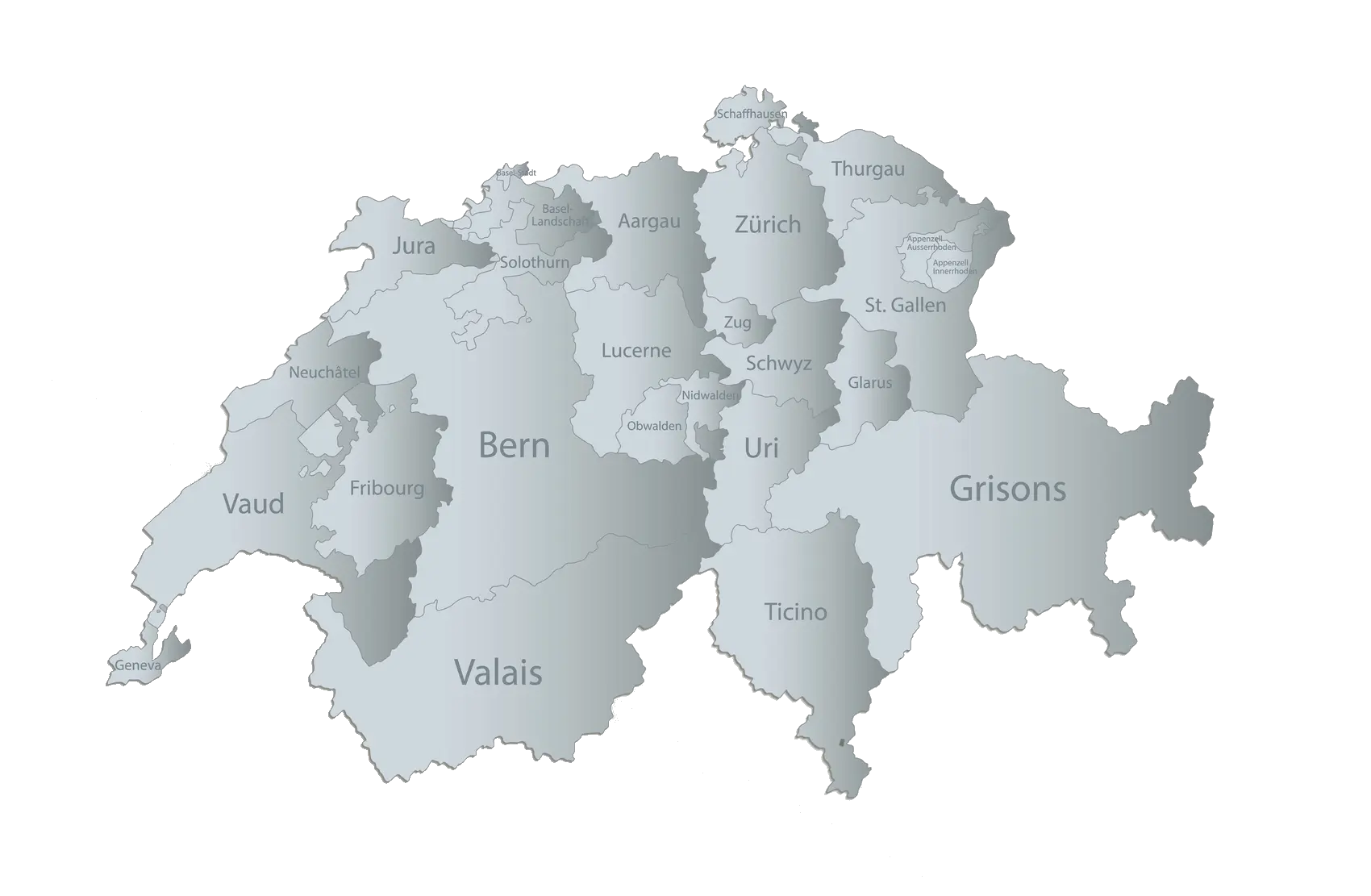
Zoomez et cliquez sur le canton désiré.
Disclaimer: This article is for information purposes only. Mortgage criteria, transfer taxes, municipal practices, bank products and property valuations can change. Always verify the current situation with the relevant canton, municipality, land registry and lender before committing to a purchase.