How are land register fees calculated?
How are land register fees calculated in Switzerland?
Land register fees (often called land register charges) are the amounts billed to officially record in the land register transactions related to your property purchase (notably the transfer of ownership and, very frequently, the registration of a mortgage note or other rights in rem); their calculation depends on the canton and generally follows one of the three models below: (1) a fee proportional to a reference value (purchase price, market/tax value, secured amount, etc.) applied via a rate in % or ‰, sometimes with a minimum and/or a cap; (2) a time-based fee (hourly rate / “per file”) that varies with complexity; or (3) a mixed tariff “per operation”, where several registrations (ownership, mortgage note, cancellations, easements, etc.) add up, which often leads to an estimate “on average around … %” rather than a single fixed rate.
Understand what land register fees cover
What is the land register used for in practice?
The land register is a public register structured “by property” (each property has its own record). It publishes and makes essential information enforceable against third parties: owner, easements, charges (mortgages / mortgage notes), etc.
In practice, when you buy a property, your ownership right is not “fully” secured until the transaction has been requested and processed by the land register (according to the cantonal procedure). It is precisely this administrative and legal activity, most often carried out by a notary, that generates land registry fees.
Which transactions trigger these fees?
Depending on the situation, the “land register” invoice may include one or several transactions, for example:
- Transfer of ownership (registration of the new owner);
- Creation / increase of a real estate charge (registered mortgage note, mortgage, etc.);
- Cancellations (e.g. removal of an old charge);
- Easements, annotations, notes, condominium ownership (PPE), etc.
This is a frequent source of confusion: you may feel you are paying “a single item”, whereas it is sometimes a combination of land register transactions (and not a simple single percentage).
How the calculation works: 3 cantonal methods to know
In Switzerland, the cantons set the tariffs (within the federal framework). Simplifying, there are three main models for the calculation of land register fees:
1) Fee proportional to value (percentage / ‰)
The calculation is based on a value base (purchase price, market/tax value, secured amount, etc.) with:
- a rate (e.g. 0.21% or 1‰),
- sometimes a minimum,
- sometimes a cap.
Typical examples: Zurich (in ‰) and Geneva (in %) for certain transfers.
Percentage of land register fees (by canton)

Methodological note (important): this chart shows land register fees only (in the strict sense), not the total acquisition costs.
- X-axis: canton index (1 to 4)
1 = ZH (Zurich)
2 = VD (Vaud)
3 = GE (Geneva)
4 = ZG (Zug) - Y-axis: land register fee rate as % of the property price
- Assumptions used:
- ZH = 0.10% (1‰)
- GE = 0.21% (standard sale “stated price”)
- VD = 0.16% (order of magnitude, varies depending on transactions)
- ZG = “equivalent %” based on an example 4h × CHF 180 = CHF 720
2) Time-based fee (hourly rate / “per file”)
Here, the bill mainly depends on processing time and/or complexity (possibly with multiplier factors). Example: Zug, with a documented stundensatz (hourly rate).
3) Mixed tariff and “per operation” logic
Some cantons (and certain local practices) resemble a “proportional” model, but with a more nuanced reality:
- tariff scales,
- rounding rules,
- amounts by type of deed,
- and above all the addition of several transactions (ownership + mortgage certificate + cancellations, etc.).
The result is often expressed as an estimate “on average around … %”, rather than a single rate set in stone.
Calculation details and numerical examples: 4 cantons (VD, GE, ZH, ZG)
Important point: below, I focus only on land register fees (without including transfer duties, notary fees, VAT on fees, etc.).
Canton of Zurich (ZH) — calculation in %, with a minimum
Zurich has a very straightforward approach: the land register fee for a transfer of ownership is stated at 1 ‰ (0.1%), with a minimum (e.g. CHF 100), and the base may be the market value.
Example (purchase at CHF 1’000’000)
- Land register fee (ownership transfer) ≈ 0.1% → CHF 1’000 (minimum not relevant here)
Quick takeaway: Zurich belongs to the group of cantons where land register fee calculation is essentially proportional (rate in %), and therefore easy to budget.
Amount of fees by property price (curves)
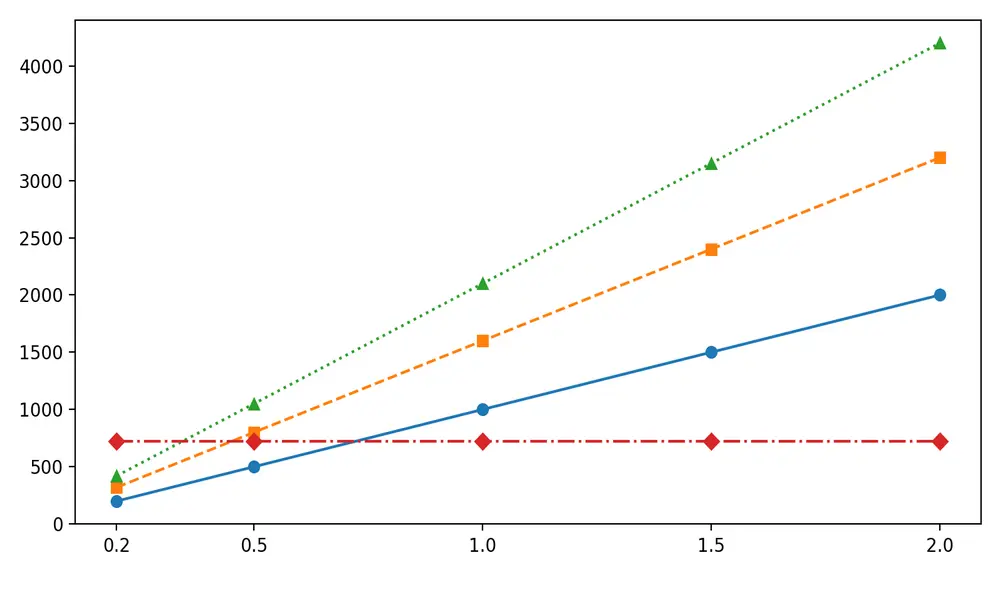
Methodological note (important): this chart shows land register fees only (in the strict sense), not the total acquisition costs.
- X-axis: property price (CHF): 200’000 / 500’000 / 1’000’000 / 1’500’000 / 2’000’000
- Y-axis: land register fees (CHF)
- Line mapping (line style + marker):
- Line 1: solid line + round marker = ZH
- Line 2: dashed line + square marker = VD
- Line 3: dotted line + triangle marker = GE
- Line 4: dash-dot line + diamond marker = ZG (fixed amount of CHF 720 in this example)
Canton of Geneva (GE) — percentage (with a cap) and case distinctions
Geneva publishes a detailed tariff guide (Land Register Office). For the transfer of ownership “stated price (or tax valuation)”, you see a fee of 0.21%, with a maximum (e.g. max CHF 40’000), and fixed amounts in certain specific cases (donation, inheritance/partition, etc.).
Example (purchase an apartment at CHF 1’000’000, transfer “stated price”)
- Land register fees ≈ 0.21% → CHF 2’100 (below the cap)
Example (transfer that is not a “classic sale”)
The same guide provides, depending on the case (donation, inheritance-partition, LFus transactions, etc.), fixed amounts or specific rules.
Quick takeaway: Geneva is part of the “proportional to value” group (in %), but you should check whether you are in a standard case (sale) or a special case (inheritance, donation, restructuring), because the calculation method can change.
Canton of Vaud (VD) — average estimate (often ~0.16% to ~0.3%), depending on transactions
When you buy a property with a mortgage in the canton of Vaud, you will frequently find references to an order of magnitude “around x%” for the land registry fees. For example, we can mention approximately 0.16% (based on the calculator of the Vaud Notaries’ Association), and numerical examples yield similar results (e.g. CHF 1’700 for a purchase at CHF 1’000’000 ≈ 0.17%).
Example (purchase at CHF 1’000’000)
- “Order of magnitude” assumption ≈ 0.16% → CHF 1’600
- Observed numerical example: CHF 1’700 → ≈ 0.17%
Why such variability? Because, depending on your file, the addition of several transactions can shift the total:
- ownership transfer,
- registration/adjustment of a mortgage note,
- cancellations,
- condominium specifics (PPE), easements, etc.
Quick takeaway: Vaud is close to the “proportional” model, but in practice you should think in terms of a range and check what is included in the “land register” line item.
Canton of Zug (ZG) — hourly billing (time-based), with factors
In the canton of Zug, a reference document (comparative table) mentions an hourly rate of CHF 180, and the possibility of applying factors (2 to 4) for cases of “particular significance”.
Illustrative example (purchase at CHF 1’000’000)
Assume 4 billable hours at CHF 180/h (illustrative assumption, as it depends on the file):
- 4 × 180 = CHF 720, i.e. an “equivalent percentage” of 0.072%.
If a factor applies (e.g. factor 2), the order of magnitude changes:
- 4h × 180 × 2 = CHF 1’440 (≈ 0.144%).
Quick takeaway: Zug clearly falls into the “time-based calculation” group. To budget properly, you should think in terms of scenarios (simple vs. complex file).
Summary: which cantons calculate “in the same way”?
- Proportional model (rate in % or ‰ on a value):
- Zurich (ZH): 1‰ / minimum
- Geneva (GE): 0.21% (standard sale), cap, special cases
- Vaud (VD): often approximated by an average % (depending on transactions)
- Time-based model (hourly rate / factors):
- Zug (ZG): CHF 180/h, possible factors 2–4
This classification helps you understand why, from one canton to another, “how to calculate my land register fees” can be either very straightforward (rate) or closer to an estimate (time/complexity).
If you have other questions about the land register in Switzerland when buying a property, then contact us and we will do our best to answer you as accurately as possible.